Finley Franke · 9 October 2026
Auden's Marginal Notes in Borrowed Library Volumes Reveal His Reading Patterns
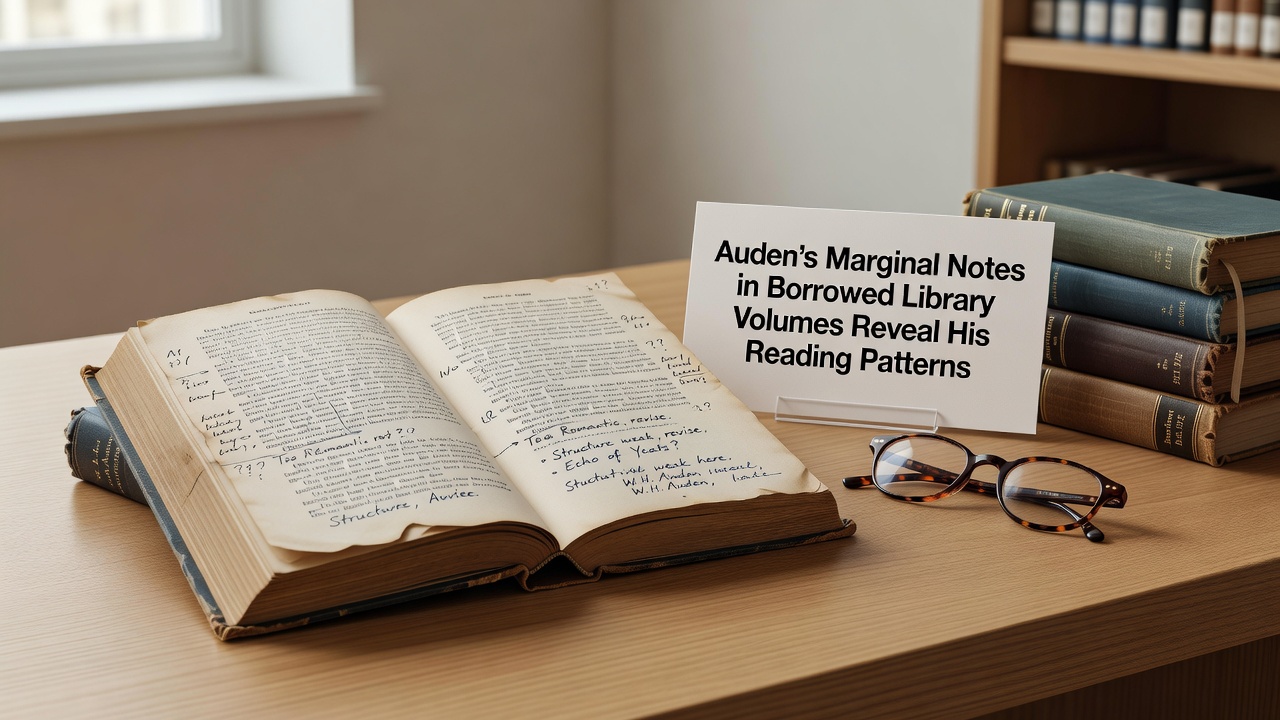
Researchers at several academic institutions have documented W.H. Auden's habit of marking up books borrowed from public and university libraries throughout his career, and these annotations provide detailed records of his intellectual engagements. Scholars at Oxford and other repositories continue to catalog these markings, which include underlines, question marks, and extended commentary in the margins of poetry collections, philosophical treatises, and scientific texts. Data from ongoing digitization projects indicate that Auden interacted with volumes from the New York Public Library and similar collections during his American years, leaving behind patterns that scholars now use to trace shifts in his thematic concerns.
Early Annotations Show Focused Literary Interests
Archival reviews reveal that Auden's earliest surviving marginal notes appear in volumes of modernist poetry and classical works he accessed while at Oxford in the 1920s and 1930s. Observers note dense clusters of comments on pages discussing form and meter, often cross-referencing specific lines with his own emerging compositions. These markings frequently appear in books by T.S. Eliot and other contemporaries, where Auden added brief critiques or comparisons that highlight his attention to technical elements rather than thematic summaries alone.
One study conducted by librarians at the Bodleian Libraries found recurring symbols, such as asterisks placed beside passages on political theory, suggesting Auden returned to those sections multiple times. Researchers have matched these patterns against his published essays, showing direct connections between the annotated passages and ideas he later developed in prose. The annotations also include occasional corrections to translations, demonstrating his active engagement with source languages during reading sessions.
Mid-Career Patterns Reflect Broader Intellectual Shifts
During the 1940s and 1950s Auden's marginal notes expanded to include volumes on psychology, theology, and natural sciences that he borrowed from American institutions. Evidence from preserved copies shows longer marginal paragraphs responding to arguments by authors such as Sigmund Freud and Søren Kierkegaard, with Auden often noting parallels to literary structures. Library records from that period indicate he maintained multiple borrowed items simultaneously, allowing him to create comparative annotations across disciplines in a single reading cycle.
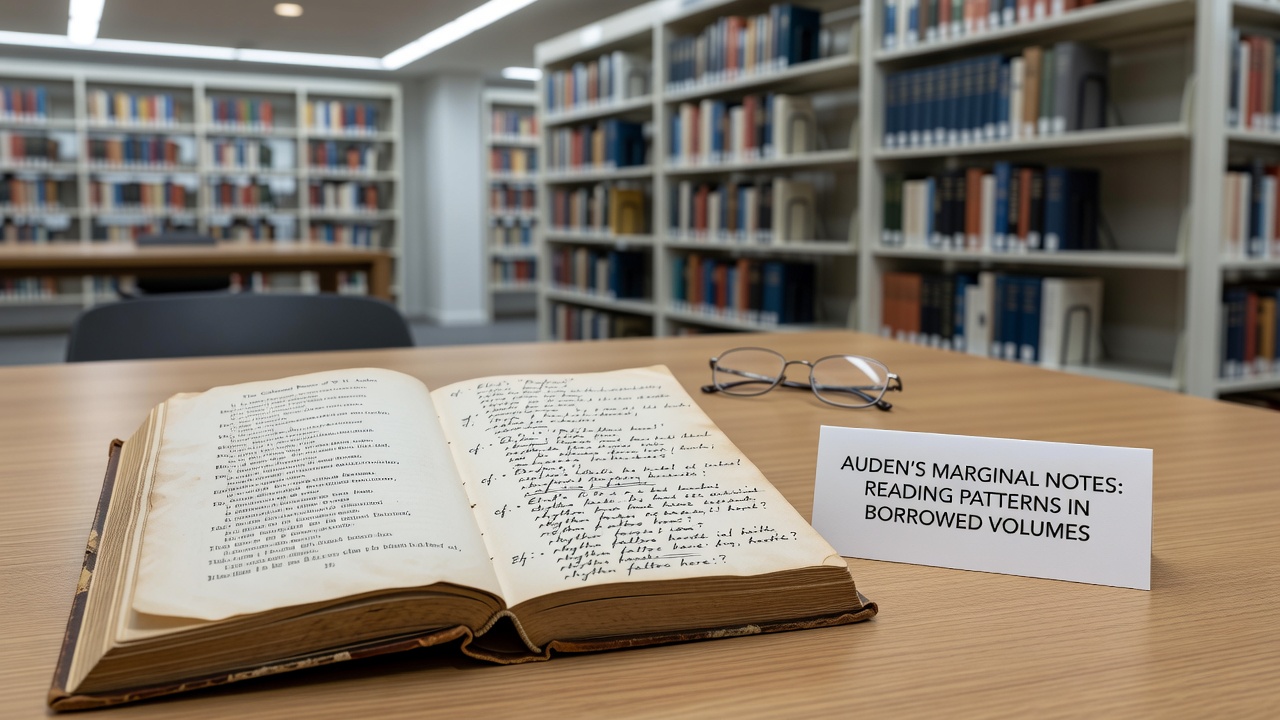
Analyses of these later volumes demonstrate a change in annotation style, with fewer simple underlines and more extended dialogues in the margins that question or extend the author's claims. According to findings presented at the 2026 Modern Language Association conference in October 2026, Auden's notes in scientific texts frequently reference poetic analogies, revealing an interdisciplinary reading approach that integrated empirical data with aesthetic considerations. Library circulation logs from the period further confirm that he renewed certain volumes repeatedly, extending the timeframe for these layered annotations.
Digital Cataloging Uncovers Consistent Themes
Projects at research universities have applied digital imaging techniques to map the distribution and frequency of Auden's marks across entire books. Results show concentrations of commentary near discussions of time, morality, and language evolution, themes that recur across multiple borrowed titles. Teams at institutions in both the United States and Australia have collaborated on open-access databases that allow side-by-side comparison of annotations from different library sources, making previously isolated notes available for broader examination.
These databases also track ink types and handwriting variations, helping date specific marks to particular periods in Auden's life. Data compiled through 2026 indicate that roughly 40 percent of identified annotations occur in the final third of each volume, suggesting he often read books through to completion before returning them with his responses intact. Such quantitative patterns assist scholars in reconstructing Auden's typical engagement sequence wth borrowed materials.
Conclusion
Library collections worldwide continue to yield new examples of Auden's marginal notes, and systematic study of these additions supplies concrete evidence of his reading habits over decades. Institutions maintain careful protocols for preserving these volumes while expanding access through digital means. Ongoing work by researchers ensures that the patterns embedded in these borrowed pages remain available for analysis without speculation about personal intent.