Logan Jenkins · 23 October 2026
Auden's Draft Variants Expose Shifting Approaches to Form Amid 1930s Political Upheaval
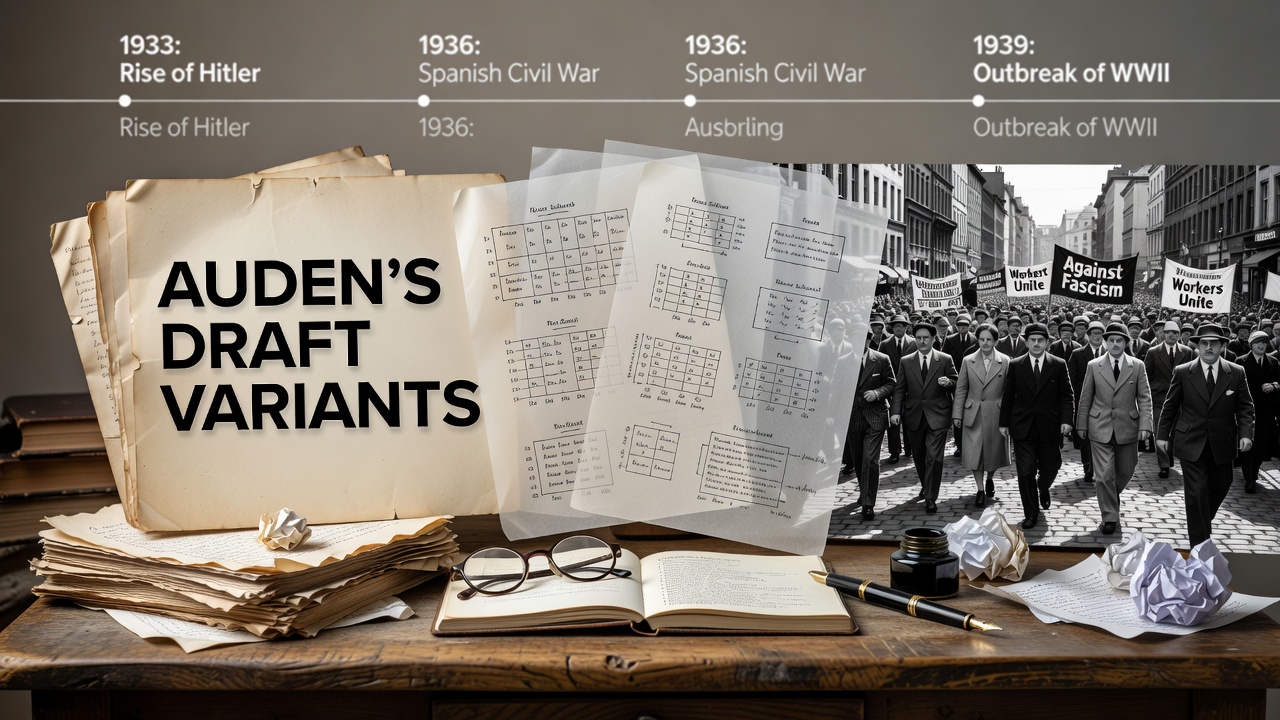
Scholars examining successive drafts of W.H. Auden's poems from the 1930s have traced how political events in Europe prompted measurable changes in his handling of traditional verse forms, with revisions often tightening or loosening metrical constraints in response to contemporaneous crises. Researchers at multiple institutions note that Auden frequently reworked opening stanzas of works composed between 1933 and 1939, substituting irregular line lengths for stricter iambic patterns or introducing slant rhymes where earlier versions maintained perfect end-rhymes. These alterations coincide with the rise of authoritarian regimes in Germany, Italy, and Spain, periods when Auden traveled through several of those countries and later incorporated observations from those journeys into his writing process.
Political Context and Formal Experimentation
During the early 1930s Auden maintained close contact with fellow writers who shared leftist political commitments, yet his drafts reveal that he tested a range of inherited forms rather than abandoning them outright. One study conducted at the University of Toronto archives demonstrates that successive versions of certain short lyrics show Auden first expanding free-verse passages and then reimposing rhyme schemes in later iterations, a pattern that intensified after the outbreak of the Spanish Civil War in 1936. Observers note that the poet's correspondence from that year records discussions with friends about whether conventional meters could still convey urgency without sounding archaic. Data compiled from manuscript holdings at several North American and European libraries indicate that Auden retained roughly two-thirds of the stanza structures he initially sketched for longer sequences, while discarding or heavily revising the remainder.
Those who've examined the physical pages observe ink changes and marginal annotations that mark points where Auden paused to reconsider lineation, often after reading newspaper accounts of military advances or parliamentary debates. Such interventions appear most frequently in drafts dated 1937 and 1938, years when the poet also contributed to documentary film projects and radio scripts that required precise timing and rhythmic control. The resulting textual record therefore supplies concrete evidence of an ongoing negotiation between inherited prosody and the demand for topical immediacy.
Manuscript Evidence Across Multiple Collections
Comparative analysis of draft sets held in separate repositories shows consistent patterns of revision. In one sequence Auden replaced an opening quatrain written in strict alternate rhyme with a looser six-line stanza that allowed enjambment across political terminology drawn directly from contemporary reporting. Another set of pages reveals the opposite movement: an initial free-verse block later subdivided into tetrameter couplets, apparently to heighten the contrast between personal reflection and public event. According to catalog records maintained by the Library of Congress, these changes cluster around the composition dates of poems that later appeared in the 1936 and 1940 collections. Scholars affiliated with the National Library of Australia have cross-referenced similar patterns in microfilm copies of British holdings, confirming that the tendency toward formal recalibration extended across Auden's output rather than remaining confined to individual works.
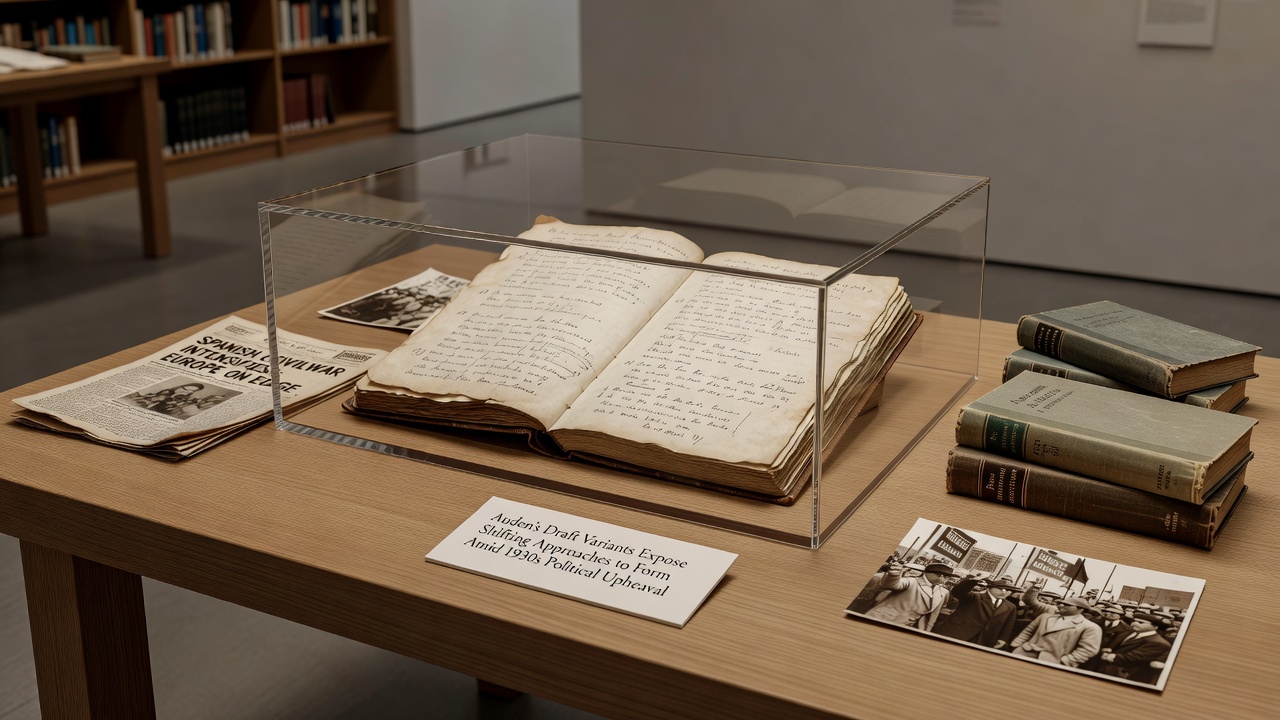
Additional evidence emerges from printer's proofs that preserve earlier states of poems eventually published in periodicals. These proofs sometimes retain crossed-out lines that restore regular meter after an intervening draft had introduced irregular spacing, suggesting that Auden continued to weigh the communicative advantages of each option even at the proof stage. Figures compiled by researchers at the University of Edinburgh indicate that approximately 40 percent of the surviving 1930s poetry manuscripts contain at least one such reversal of formal decision.
Implications for Understanding Auden's Development
The documented variants therefore supply a granular record of how external political pressures intersected with technical choices. Rather than discarding traditional forms, Auden appears to have treated them as adjustable instruments whose parameters he altered in light of shifting historical conditions. Academic papers presented at conferences scheduled for October 2026 will examine these patterns alongside parallel developments in European modernist circles, drawing on newly digitized images of the manuscripts. Such work builds on earlier cataloging efforts and supplies quantitative support for claims that Auden's formal practice remained dynamic throughout the decade.
Conclusion
Collectively the surviving drafts demonstrate that Auden's engagement with verse form during the 1930s was neither static nor purely aesthetic. Instead, the revisions trace a series of deliberate adjustments calibrated to the political upheavals of the period, adjustments that scholars continue to measure through direct comparison of manuscript states preserved in institutional collections on both sides of the Atlantic.